Principles are ways of successfully dealing with reality to get what you want out of life.
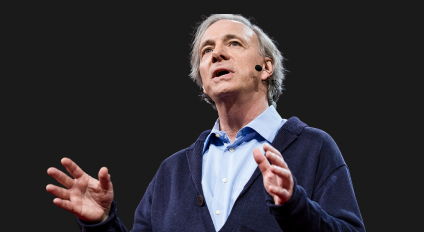
Ray Dalio, one of the world’s most successful investors and entrepreneurs, cites principles as his key to success.
Principles are ways of successfully dealing with reality to get what you want out of life.
Ray Dalio, one of the world’s most successful investors and entrepreneurs, cites principles as his key to success.
In 1975, Ray Dalio founded Bridgewater Associates, out of his two-bedroom apartment in New York City. Over forty years later, Bridgewater has grown into the largest hedge fund in the world and the fifth most important private company in the United States (according to Fortune magazine), and Dalio himself has been named to TIME’s list of the 100 most influential people in the world. Along the way Dalio discovered unique principles that have led to his and Bridgewater’s unique success. It is these principles, and not anything special about Dalio, that he believes are the reason behind whatever success he has had. He is now at a stage in his life that he wants to pass these principles along to others for them to judge for themselves and to do whatever they want with them.
As a professional decision maker, I have spent my life studying how to make decisions effectively and have constantly looked for rules and systems that will improve my odds of being right and ending up with more of whatever it is that I am after.
One of the most important things I've come to understand is that most of the processes that go into everyday decision making are subconscious and more complex than is widely understood. For example, think about how you choose and maintain a safe distance behind the car in front of you when you are driving. Now describe the process in enough detail that someone who has never driven a car before can do it as well as you can, or so that it can be programmed into the computer that controls an autonomous car. I bet you can't.
Now think about the challenge of making all of your decisions well, in a systematic, repeatable way, and then being able to describe the processes so clearly and precisely that anyone else can make the same quality decisions under the same circumstances. That is what I aspire to do and have found to be invaluable, even when highly imperfect.
While there is no one best way to make decisions, there are some universal rules for good decision making.
Yep. Gut feeling is intuition which comes from the subconscious part of the brain. It can be extremely valuable or very misleading. I find that when I review my gut feeling intuitions with my logic and my logic with my gut feeling intuitions, and they align, I’m usually good to go. However, if I’m making a really important decision I will also find the smartest people on the subject I’m thinking about who will disagree with me to have them stress-test my thinking and I will consider their logic. If you do all that it’s almost hard to be wrong.
You can read about the tools I use in the appendix of my book, Principles. If you don’t have it, you can get free (with other good stuff) as an app called Principles in Action which you can find on the iOS Apple App Store.
Always go to the higher level and simplify. Practice thinking in simple principles. Practice simple thinking including trying to be clear to young kids who keep asking why.
The key to success lies in being able to align one’s subliminal wants with one’s intellectual wants and to do that with the help of triangulating with others. In others words, if you align what you emotionally want with what you intellectually want that’s a big deal, but you’re still only halfway to assured success. That’s because you alone can not see everything. So, if you can triangulate well with highly believable others who care about you (using the technique described in my book Principles) you will make the other big step that will lead you to make the best decisions possible.
Gut feelings are subliminal messages; they can be excellent or terrible. That is why they should be reconciled with one’s logic. When both the emotional and the intellectual line up, not just in your own mind, but also with the triangulation of thoughtful others, you probably have a good choice.
I agree with you. As you noted, these principles and tools that yielded remarkable results for me and large numbers in most areas. Please pass them along to everyone you want to help.
I will be doing as you suggest - I.e., I will be passing along these tools and providing interactive courses for those who want them. To do this the main people who did it at Bridgewater will spilt out from Bridgewater to provide the same things that they are providing to Bridgewater to any company who wants to get these things. This way of operating has proven so personally and organizationally effective that this group of people is extremely excited to share it with others.
I urge you to use my app “Principles in Action” that you can get for free on the Apple App Store because there’s a feature in it called the Coach that will find for you the appropriate principles for the particular situations you face. Basically you tell it what what your problem is and it gives you the appropriate principles for dealing with it well. People keep it on their iPhone (it will soon be available on Android) and access it regularly. It’s rates 4.9 so they love it.
Like everything in life there’s a point at which the marginal gains are not worth the marginal time or money costs and one has to know where that point is and move to others things when one reaches it. What I found most effective from my systemized-computerized process is that it never forgets and it can process vastly more than my brain can process using my thinking. So, all my marginal learning is built on my past learning so I compound my learning and can think much faster and about more complicated stuff than if I didn’t convert my principles into computer code and use the computers.
I think most of what most people do is driven by their subliminal thinking (what I call their lower level thinking) and the habits they develop and that the biggest differences between people who are “successful” at getting out of life what the really want and those who don’t are due to their a) getting to know and reconcile their two thems (the lower level subliminal and the upper level logical) and b) their acquiring the right habits to get them what they want. Said differently, learning to manage oneself to get what one wants is critical to one’s success in life.
You can, and I do, come up with systematic ways of repeatably making good decisions (i.e., principles) by first and foremost thinking in a principled way by which I mean going above the individual situations that are coming at you and looking down on them as situations that repeatedly happen in mechanical ways and then realizing that you can engineer how they happen. For example, in the case of decision making you and others who you make decisions with should step above your decision making to decide how you should be with each other to make decisions and then do that, see how it goes, step above it again to reflect how it’s going and modify it to be better, and so on. That process will get you what you want.
Ideas that come from the “gut” are really ideas that come from the subliminal mind. They can be invaluable or bad. The best way to find out and to make decisions is to check them with your conscious logic and those of others. When you triangulate well - between your and others’ subliminal and logical minds - you will make radically better decisions than if you don’t.
At least 3 characters are required to perform a search