Principles are ways of successfully dealing with reality to get what you want out of life.
Ray Dalio, one of the world’s most successful investors and entrepreneurs, cites principles as his key to success.
Principles are ways of successfully dealing with reality to get what you want out of life.
Ray Dalio, one of the world’s most successful investors and entrepreneurs, cites principles as his key to success.
In 1975, Ray Dalio founded Bridgewater Associates, out of his two-bedroom apartment in New York City. Over forty years later, Bridgewater has grown into the largest hedge fund in the world and the fifth most important private company in the United States (according to Fortune magazine), and Dalio himself has been named to TIME’s list of the 100 most influential people in the world. Along the way Dalio discovered unique principles that have led to his and Bridgewater’s unique success. It is these principles, and not anything special about Dalio, that he believes are the reason behind whatever success he has had. He is now at a stage in his life that he wants to pass these principles along to others for them to judge for themselves and to do whatever they want with them.
Just as your brain has its conscious upper part and its subconscious lower part, it also has two halves called hemispheres. You might have heard it said that some people are more left-brained while others are more right-brained. That's not just a saying--Caltech professor Roger Sperry won the Nobel Prize in medicine for discovering it. In a nutshell:
The diagram here summarizes the qualities of "right-brained" and "left-brained" thinking types.
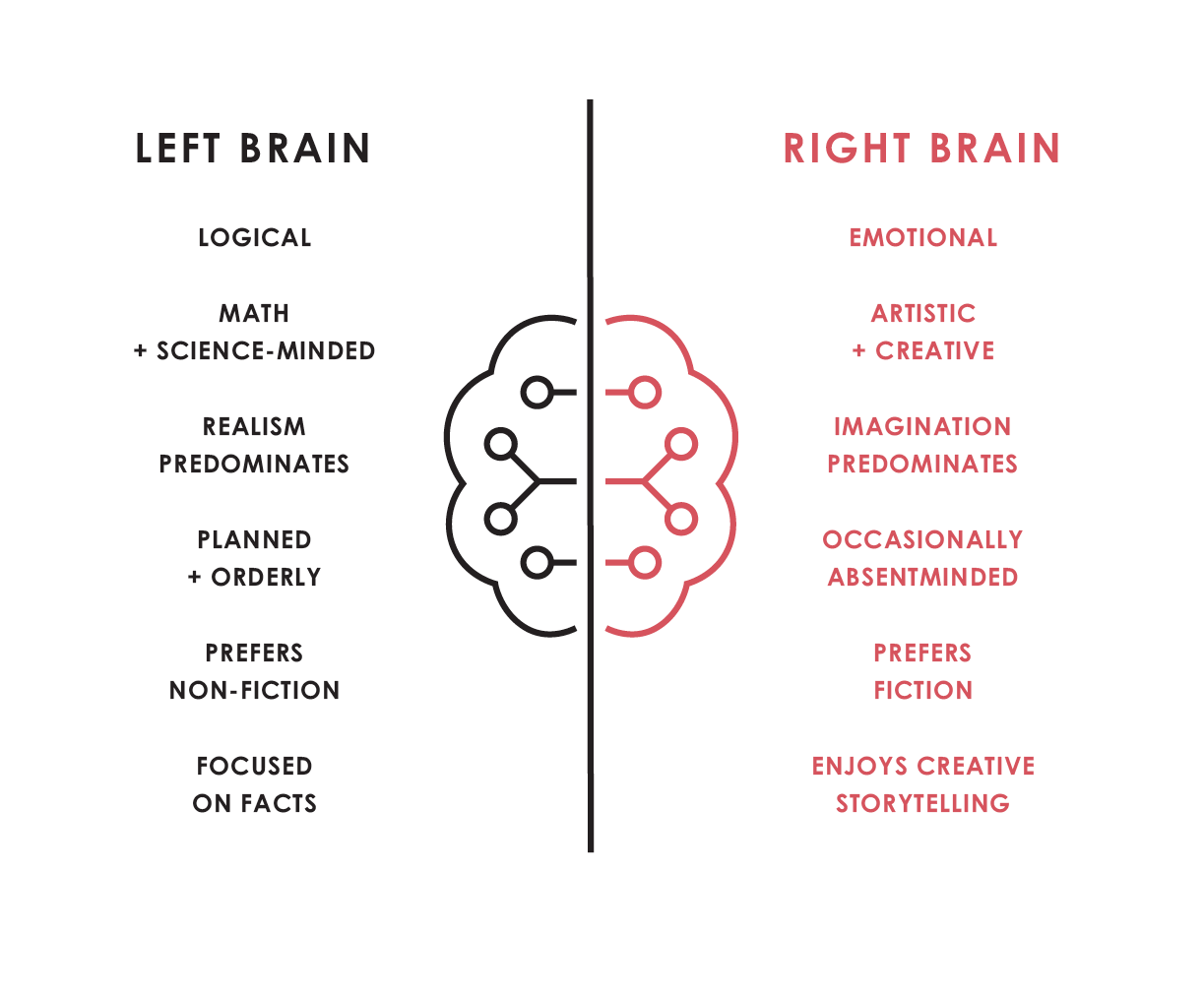
Most people tend to get more of their instructions from one side than the other and they have trouble understanding people who get theirs from the opposite side. Our experience has been that leftbrained folks tend to see right-brained folks as "spacey" or "abstract," while right-brained thinkers tend to find left-brained thinkers "literal" or "narrow." I have seen wonderful results occur when people know where their own and others' inclinations lie, realize that both ways of thinking are invaluable, and assign responsibilities accordingly.
Everyone I’ve met is more one or the other. It’s like being left-handed or right-handed. You can tell which you are by seeing how you’re inclined to approach things when they’re thrown at you. For people who want to learn more about their inclinations, they have the option of answering questions about their reactions to cases in “Principles in Action”(which is free in the Apple App Store) and answering questions in our Assessment Center which will be put in “Principles in Action” in a couple of months.
At least 3 characters are required to perform a search